

The Ultimate Guide to Tattoo Equipment for Beginners
There’s nothing quite like the buzz of your first machine, but let’s be honest: figuring out what tattoo equipment beginners actually need can feel like trying to solve a Rubik’s Cube blindfolded.
Between decoding needle sizes, choosing between rotary pen setups and old-school coils, and figuring out which kit you need in your rotation, it can be easy to get overwhelmed. At Barber DTS, we’ve been supplying world-class studios, master artists, and fresh apprentices across the UK with top-tier gear for decades.
In this guide, we’ll break down how to choose a reliable tattoo kit for beginners, explain how to pick the best tattoo machine, demystify needle configurations, and share essential safety advice so you can start practising with confidence.
Contents
What do you need in a tattoo kit for a beginner?
Rotary VS Coil: What’s the best tattoo machine for beginners?
How to choose the right tattoo stencils for beginners
Finding the right tattoo needle size for beginners
Essential tattoo tips for beginners
What do you need in a tattoo kit for a beginner?
When you’re starting an apprenticeship, buying random bits of kit often leads to mismatched gear that might not work together. Getting a complete tattoo kit for beginners, or building one from scratch with professional-grade components, makes sure everything works seamlessly from day one.
To get up and running without breaking the bank or compromising on quality, here is your non-negotiable starter checklist:
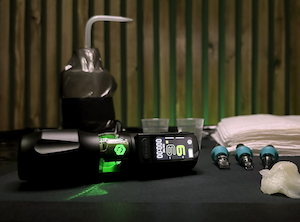
- A reliable tattoo machine — This is the absolute powerhouse of your station. You need a machine that offers smooth power delivery, minimal vibration, and an ergonomic grip that won’t give you hand cramps during long practice sessions.
- Power supply and connections — A steady voltage source (or a wireless battery pack) to keep your motor running smoothly without dangerous power spikes.
- Needles and cartridges — A tailored selection of liners and shaders so you can start practising clean linework and smooth shading.
- Practice skins — High-density synthetic skin sheets to build your hand speed, muscle memory, and depth control long before you touch human skin.
- Stencil supplies — Thermal stencil paper, transfer gel, and skin markers to turn your art into clean, crisp outlines.
- Personal Protective Equipment (PPE) and hygiene — Nitrile gloves, barrier film, machine bags, clip cord sleeves, and hospital-grade surface disinfectants. Never cut corners here!
- A dedicated tattoo kit — From artist custom kits and style custom kits, we have a wide range of curated bundles that include everything you need for those who demand performance, reliability, and value all in one.
- Apprentice tattoo kit — Get the right start from day one with dedicated tattoo kits for apprentices. These kits include machines, cartridges, ink, practice skins, and more studio essentials, so apprentices can feel supported as they progress through their tattoo journey.
If you want to make sure your gear is matched to perfection without the stress of guessing, picking up a professional, curated starter set from a trusted UK supplier is the smartest move you can make.
Rotary vs coil: What’s the best tattoo machine for beginners?
When it comes to choosing a beginner’s setup for a tattoo, the industry consensus has shifted dramatically in recent years.
While traditional coil machines are brilliant for heavy-duty lining and classic styles, they require a lot of technical know-how to tune, adjust springs, and maintain. For someone just stepping into the craft, rotary machines, particularly wireless pen-style rotaries, are usually a winning choice.
| Feature | Rotary Tattoo Machines | Coil Tattoo Machines |
| Maintenance | Very low; simple plug-and-play operation | High; requires manual tuning and spring adjustments |
| Weight and handling | Lightweight, ergonomic, and low-vibration | Heavy and top-heavy; can cause wrist fatigue |
| Noise level | Quiet, smooth motor humming | Loud, distinctive buzzing sound |
| Versatility | Excellent all-rounder for lining, shading, and packing | Specialised, usually set up specifically as a liner or shader |
| Learning curve | Gentle; feels natural like holding a marker | Steeper; requires mechanical tuning knowledge |
A modern rotary pen offers a comfortable, lightweight feel that mirrors a heavy drawing pen, making depth control significantly easier while your hand strength builds. When people search for tattoo guns for beginners, what they really need is a smooth, reliable rotary pen machine that won’t fight against them while they learn.
If you want to weigh up the mechanics in more detail, check out our guide on rotary vs coil machines.
How to choose the right tattoo stencils for beginners
A tattoo is only as good as the stencil underneath it. If your stencil wipes away three minutes into a practice session, you’re left guessing your lines, and that can be a recipe for a quick mess.
Mastering tattoo stencils for beginners is an absolute rite of passage for every apprentice.
Stencil paper and transfer gel essentials
To get a crisp stencil that sticks like glue to your practice skin, you need two things: high-quality carbon stencil paper and a professional transfer gel.
- Thermal carbon paper — You can hand-trace your design using a ballpoint pen onto the master sheet, or run it through a thermal stencil printer for complex pieces.
- Transfer prep — Clean the practice skin thoroughly with rubbing alcohol to remove any residual oils from manufacturing.
- Application — Apply a tiny drop of stencil gel (a little goes a long way!), spread it evenly until the skin feels tacky, press your stencil down firmly, and smooth it out from the centre to the edges.
- Drying — Let your stencil dry completely on the synthetic skin for at least 12 to 24 hours before you start tattooing. Synthetic skin doesn’t absorb stencil ink like real skin, so letting it air-dry stops it from smudging away when you wipe away excess ink.
Finding the right tattoo needle size for beginners
Walking into a room full of needle boxes can feel like trying to read a secret language. You’ll see codes like 1207RL or 1009RM, and it’s easy to feel lost. Let’s decode the system so you know exactly what you’re putting in your grip.
Understanding needle codes
Needle codes tell you three main things: gauge (thickness of the needle), count (number of needles), and configuration (how they’re grouped).
- 1207RL — The 12 stands for #12 gauge (0.35mm needle diameter), 7 means 7 needle pins in the group, and RL stands for Round Liner.
- 1009RM — The 10 stands for #10 gauge (0.30mm bugpin diameter), 09 means 9 needle pins, and RM stands for Round Magnum (curved magnum).
Recommend needle sizes for apprentices
When you’re just starting out, keep your needle selection small and simple. Trying to learn with twenty different configurations will only confuse your technique! Here’s the ideal tattoo needle size for beginners:
- 3RL and 5RL (round liners) — Fantastic for practising fine linework, detailed script, and small geometric shapes.
- 7RL or 9RL (round liners) — Slightly thicker needle groupings that build confidence for pulling bold, solid traditional outlines.
- 7RM or 9RM (curved magnums) — Perfect for layering soft black and grey shading and packing colour evenly without harsh edges.
Today’s rotary machines rely heavily on safety needle cartridges — self-contained units that snap straight into your grip with an internal membrane to stop blood and ink from flowing back into your machine motor or grip. To get a complete rundown on tapers, gauges, and configurations, dive into our ultimate tattoo needle guide.
Essential tattoo tips for beginners
Now that the physical setup is coming together, let’s talk about the habits that can make or break designs. Applying great tattoo tips for beginners early on means you build muscle memory safely without developing bad habits that are hard to unlearn later.
According to safety guidelines from the UK Health and Safety Executive (HSE) and local council environmental health departments, all professional tattooing must take place in a licensed, hygienic space using medical-grade infection control protocols to protect against blood-borne viruses like Hepatitis B, Hepatitis C, and HIV.
1. Master synthetic skin first
We can’t stress this enough: never tattoo human skin until your mentor gives you explicit permission! Synthetic practice skins allow you to make mistakes, test voltages, and perfect your hand speed completely risk-free.
Focus on pulling long, continuous lines in a single pass without stopping, while keeping a close eye on your needle depth (typically 1.5mm to 2mm hanging out of the tip).
If the back of your practice sheet tears or bulges, that’s your cue that you’re pressing too deep. Learning how to practice tattooing as an apprentice on fake skin gives you the freedom to build your confidence long before you take on your first client.
2. Hygiene is non-negotiable
Tattooing is an invasive procedure that breaks the skin, meaning cross-contamination risks are serious business. Treat your station like a sterile surgical bay by using pre-sterilised, disposable needle cartridges, single-use grips, and disposable ink caps every single time.
Before you set up or break down, wipe your workspace clean with hospital-grade surface disinfectants, and wrap your machine, power supply, clip cords, and wash bottles in fresh barrier film.
Always wear nitrile or latex gloves during setup and tattooing, and ensure you swap them out immediately if you touch a non-sterile surface, like your phone, chair, or clothing.
3. Perfect your body mechanics and ergonomics
Tattooing might look like you’re just sitting and drawing, but running long practice sessions will quickly show your back and wrists who’s boss.
Set up your station so your body sits naturally without hunching over your practice skin. Keep both feet flat on the floor, anchor your tattooing hand securely against the work surface to eliminate hand shakes, and take short stretch breaks between passes.
Building solid ergonomic habits right now will save you from painful wrist fatigue and keep you tattooing comfortably for decades.
4. Understand voltage vs hand speed
One of the trickiest parts of setting up your station is finding the sweet spot between your power supply (or battery) voltage and how fast your hand moves across the skin. If your machine is running at high voltage but your hand moves too slowly, you’ll chew up the practice skin and leave blow-out lines.
Similarly, if your hands move like lightning while your voltage is set low, your machine will skip, leaving dotted, incomplete linework.
Spend time running tests on synthetic skin to smoothly match your hand movements to your machine’s stroke rate until pulling a clean line feels like second nature.
5. Prioritise stencil care
A masterpiece is only as good as the stencil underneath it, and a smudged blueprint will leave you guessing your lines halfway through a pass.
Clean your practice skin thoroughly with rubbing alcohol to strip away any surface oils before applying a tiny drop of professional stencil gel. Smooth your transfer paper down evenly from the centre outwards to avoid air bubbles, and let it dry completely for at least 12 – 24 hours before touching it with a needle.
Taking extra time with your stencil prep prevents smearing when you wipe away excess ink, keeping your working area clean, clear, and stress-free.
FAQs
Can I teach myself to tattoo at home with a starter kit?
While buying a tattoo kit for beginners is a fantastic way to practice linework on fake skin at home, you should never attempt to tattoo real people outside a licensed studio setup.
Professional tattooing requires hands-on mentoring from an experienced artist to master health, safety, skin anatomy, and cross-contamination rules safely.
How much should I expect to spend on my first beginner setup?
You don’t need to spend thousands of pounds on day one, but you should avoid dirt-cheap kits from unregulated online marketplaces at all costs!
A high-quality, safe beginner setup — including a reliable rotary machine, digital power supply, safety cartridges, practice skins, stencil supplies, and medical hygiene gear — typically costs between £150-£500 from a reputable industry supplier, like Barber DTS.
Do I need a foot pedal if I use a rotary pen machine?
Not necessarily! While many artists still prefer using a classic foot pedal to toggle power on and off, many modern digital power supplies and wireless battery packs feature continuous run modes or built-in switches, giving you total freedom over your setup.
Upgrade your station with Barber DTS
Starting your journey as a tattoo artist is an incredible milestone, and having the right equipment in your hands makes all the difference. By investing in reliable, professional-grade gear from day one, you set yourself up for cleaner lines, faster learning, and total peace of mind.
Ready to build your dream setup? Explore our complete range of industry-leading tattoo machines, premium needle cartridges, power units, and more. Or, head over to our blog to find out everything you need to know about tattooing.
 What is a Prince Albert Piercing? The Ultimate Guide
 The Best Tattoo Ink 2024
 How Often to Wash a New Tattoo? A Complete Guide
 Tattooing Over Stretch Marks, Moles, Scars And Other Skin Conditions
 The Best Tattoo Machines 2024: Top Picks for Tattoo Artists